Please, Thank Yous, and the Subtle Art of Asking for Exactly What You Want
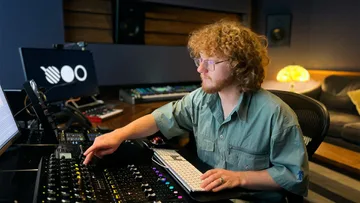
String and Tins sound designer and creative director Culum Simpson weighs in on voice directing and how specificity transforms performance.
'Can you make it..more conversational...' the person behind me mumbles through a mouthful of salmon nigiri, 'like you're talking to a mate in the pub?'
The look on the voiceover’s face is a familiar one: What do you mean a pub? And why would we be talking about discounted pears? Then, summoning the best acting they've done in their career with a confident "...sure", they deliver the line identically… only slightly quieter and arguably, less coherent.
Commonplace, generalised phrasing used in feedback has been the backbone of voice records for longer than I've been in the industry, and I understand its appeal. The desire for a shared nomenclature gives everyone involved a common understanding when speaking two different creative languages and provides distance from stickier, more difficult conversations. But what happens when one needs to go further, when the gentle approach just won't do? When “can you give it another 10%” doesn't make an adequate explanation for the entire breadth of human emotion. It’s curious that the most opinionated people in the room often recoil when they have to give an actor feedback that is any more specific than 'more energy,’ 'less energy,' 'faster,' or 'slower.'
Having started my working life as an actor and later finding out I had a better face for audio post, I fully understand the reticence behind frank feedback. Actors can be emotional creatures, that's what makes them so captivating. But they are also craftspeople, cut from the same cloth as any art director, copywriter, or sound designer. 'The Process', is something inherent in all creatives; the journey of discovery is important to the final product. People will pore over a script for months to distil it into the best version of itself. They’ll run ideas through multiple rounds of research to make absolutely sure it reaches the target audience. The devil is in the details, but when it comes to informing a real, living, breathing human, of what is required of them, we take a back seat. ‘A bit more light and shade please,’ ’Just push it a little more.’ Unclear… and unhelpful. An actor is the instrument of dramatisation, to be wielded as you would a pen, or a brush or in my case a Sennheiser AVX-ME2 SET-3. And like all instruments of creativity, voiceovers sometimes need a little guidance.
Given my unique position, having been in the booth as well as the control room, I can tell you that the more explicit you can be, the better. I understand wanting to spare a performer's feelings, but being specific isn't inherently unkind. I would much rather be told precisely what to do, and leave the session in the rosy glow of a job well done, than hear the telltale 'can they hear us...' from the control room, followed by silence and an impromptu game of charades through the booth window whilst my latest attempts are being discussed...without me.
To offer an analogy; in music, a written score is clear, offering a framework for the musician to follow. Instructions on tempo, dynamics, where to rest, and where to stress notes. That rigid structure allows the performer to play around and add the magic that makes them unique as a player... which is why you hired them in the first place. There's a lesson to be learned from this that can cross over to the world of voice directing. Swap time signature for meter, and notes for inflection...and the first chair for a Herman Miller, of course.
We may not think of spoken word as an art akin to music because it's something we use daily but voice performance is a skill as complex as playing the piano; we've all just had a lot more practice at the basics. So why not be that specific when it's words on the page as opposed to notes? "Can you put a beat there, put the stress on that syllable, a slightly longer pause at the final comma, then finish with a strong downward inflection, please?" They may come back with thoughts of their own and scripts become littered with raving scribbles. Notes, sketches, hieroglyphs, turning our humble script into something that looks like the score for Handles Massiah... hallelujah indeed.
You provided the words, intention, and rhythm. They provide the emotion, humour, and charm. Two craftspeople tackling a problem from two different perspectives to create one unified result. We're all in the business of crafting: a script, a piece of music, a performance, but sometimes, raw instinct isn't enough to do all of the making. In these instances, it’s easy to get lost in the weeds of abstract idioms, but if you find yourself at take 75, four flat whites in, remember clarity will bear conversation, and, in turn, conversation will carry the craft.
So be clear, be kind, and if all else fails... just have fun with it.